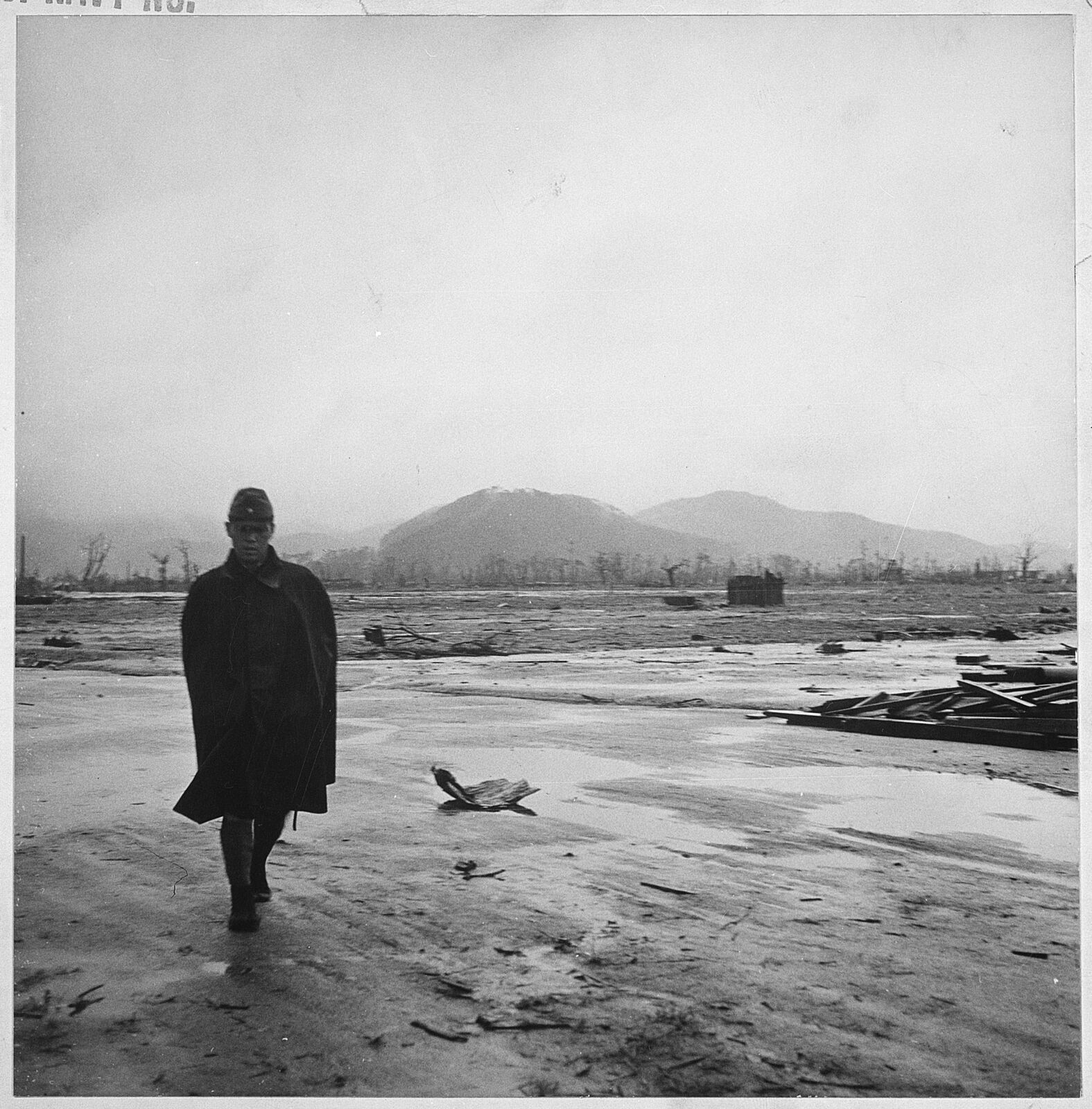
WASHINGTON, Aug. 6.—One bomb, one plane, one city, Hiroshima: the United States has turned against Japan the force that lights the sun. President Truman announced today that an American airplane had struck Hiroshima with a weapon more powerful than 20,000 tons of TNT.
His statement called the atomic weapon a harnessing of “the basic power of the universe.” The bomb, the statement said, has more than 2,000 times the blast power of the British “Grand Slam,” until now the largest bomb used in war.
No clear account of conditions in the city was available in the first reports.
Japan’s leaders rejected the Potsdam terms, the President said; another refusal would bring further attacks and a “rain of ruin.”
Mr. Truman called the undertaking, which cost two billion dollars, the greatest scientific gamble yet attempted. About 125,000 people worked on the plants at the height of construction, and more than 65,000 operate them now. Many labored for two and a half years without being told what they were producing.
The President said he would ask Congress to create a commission governing the production and use of atomic power in the United States.
By supper time people who had never spoken the word “atomic” were saying it at every table. They were glad the war might soon be over, and uneasy at what had been let loose.
The machine behind the first attack was a B-29 Superfortress named Enola Gay, piloted by Paul Tibbets from a base in the Marianas. At 8:15 in the morning, local time, the bomb exploded over Hiroshima.
THREE DAYS LATER, NAGASAKI
Three days later, on Aug. 9, another atomic bomb struck Nagasaki. Major Charles Sweeney commanded the Superfortress that carried it. He found the first target, Kokura, hidden by haze and smoke. He turned for Nagasaki, where cloud cover obscured the city as well. The bomb burst at 11:02 in the morning, local time, 1,650 feet above the city.
On Aug. 10 Japan offered to accept the terms, provided the prerogatives of the Emperor were not prejudiced.
IN HIROSHIMA, A MONTH AFTER
TOKYO, Sept. 16.—A Swiss doctor of the International Red Cross has come back from Hiroshima after a five-day relief mission to the city struck by the first atomic bomb.
Dr. Marcel Junod is chief delegate in Japan of the International Committee of the Red Cross. He reached the city on Sept. 9 with about twelve tons of medicines and medical equipment. An American investigating party and two Japanese doctors went with him. He visited the principal hospitals still standing, gave out the supplies and treated patients himself.
He went on word from a fellow delegate. Fritz Bilfinger of the committee reached Hiroshima at the end of August and on Aug. 30 telegraphed Dr. Junod in Tokyo describing what he found there. Dr. Junod then went to Allied headquarters, which let him carry the medicine to the city in person.
Nearly every hospital and treatment center in Hiroshima was destroyed by the bomb. Since then the injured have been tended wherever shelter could be found: in concrete buildings left standing, on dry riverbeds and beside the footings of bridges.
Medicine, bandages and every kind of first-aid supply have run desperately short. Rescue work was led at first by the Army’s marine headquarters at Ujina, joined by doctors who survived and by relief teams from Kure, Hatsukaichi and nearby towns. Neighborhood defense groups and women’s associations nursed the rest.