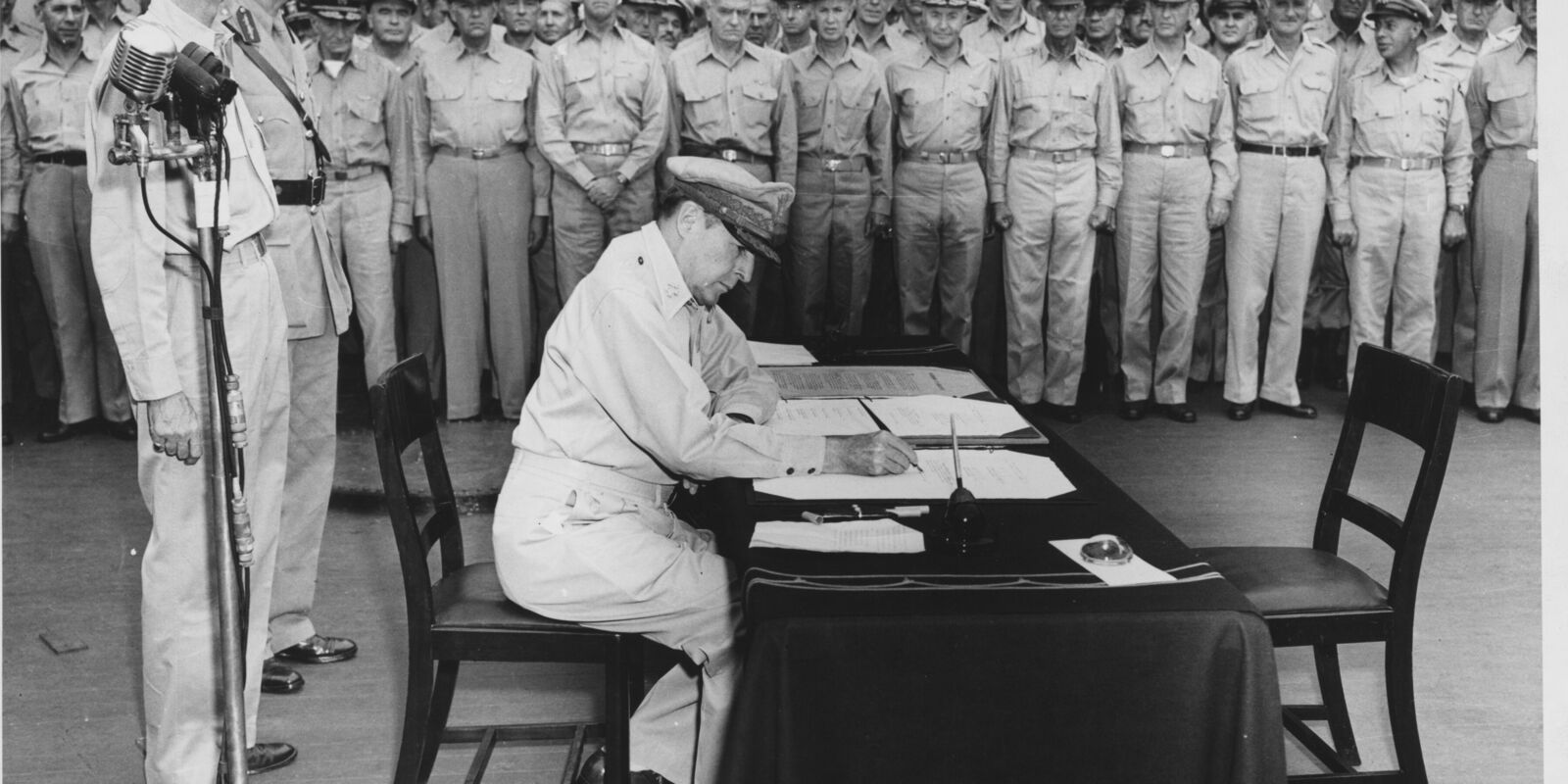
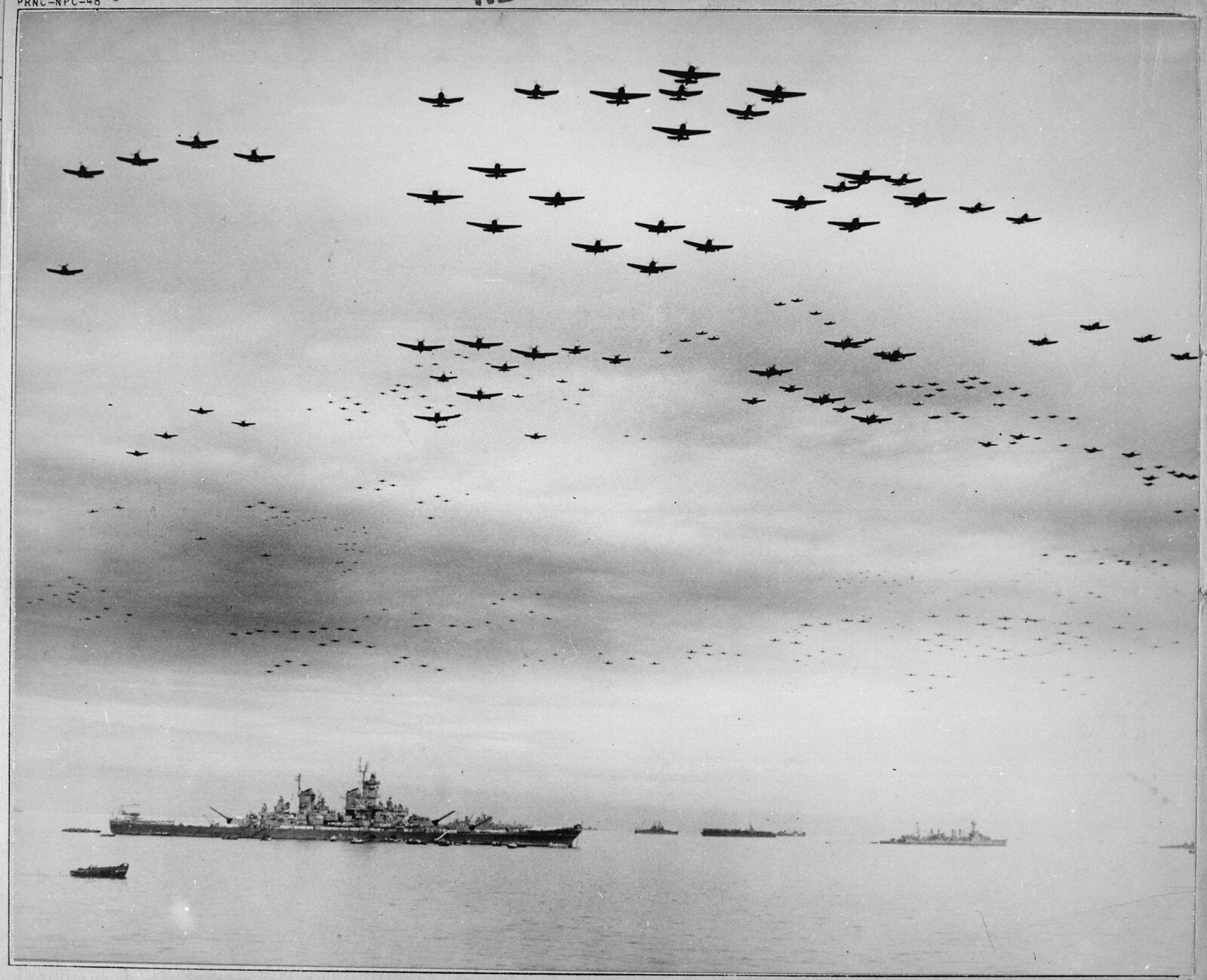
ABOARD U.S.S. MISSOURI, TOKYO BAY, Sept. 2.—The six-year world war ended this morning when Japan signed the surrender on the deck of an American battleship, the Missouri. A heavy overcast covered Tokyo Bay as Japan’s envoys came aboard and surrendered their armed forces wherever they stood.
The ceremony began just after 9 o’clock and lasted 23 minutes. Japan’s Foreign Minister, Mamoru Shigemitsu, walked with a cane. He signed for the Emperor and the Japanese Government. General Yoshijiro Umezu signed for Imperial General Headquarters.
General Douglas MacArthur accepted the surrender for the Allied Powers. Two generals stood beside him, Jonathan Wainwright and A. E. Percival. Both had surrendered to the Japanese early in the war, Wainwright on Corregidor and Percival at Singapore. They had spent more than three years as prisoners. General MacArthur signed with six pens and handed one each to them. Fleet Admiral Chester W. Nimitz signed for the United States.
Above the deck hung a framed flag. Commodore Matthew Perry had flown it in Tokyo Bay in 1853, when his ships came to open Japan to American trade.
Then the other Allied nations signed, one at a time:
- China: General Hsu Yung-chang
- The United Kingdom: Admiral Sir Bruce Fraser
- The Soviet Union: Lieutenant General Kuzma Derevyanko
- Australia: General Sir Thomas Blamey
- Canada: Colonel L. Moore Cosgrave
- France: General Philippe Leclerc
- The Netherlands: Lieutenant Admiral Conrad Helfrich
- New Zealand: Air Vice-Marshal Leonard Isitt
“Let us pray that peace be now restored to the world, and that God will preserve it always,” General MacArthur said after the last signature. Then he closed the proceedings.
One signature on the Japanese copy fell on the wrong line, and the Japanese delegates objected. The national titles were corrected by hand, and then they accepted their copy. Allied prisoners were already coming aboard hospital ships in the bay.
At home it was still Saturday night, and the radio stayed on. In houses with a son or a husband in the Pacific, people let themselves say out loud that he would be coming home. President Truman spoke to the nation in a broadcast. “The thoughts and hopes of all America—indeed of all the civilized world—are centered tonight on the battleship Missouri,” he said. “There on that small piece of American soil anchored in Tokyo Harbor the Japanese have just officially laid down their arms.”
“Four years ago the thoughts and fears of the whole civilized world were centered on another piece of American soil—Pearl Harbor,” the President said. “We shall not forget Pearl Harbor. The Japanese militarists will not forget the U.S.S. Missouri.”
He proclaimed Sunday, Sept. 2, to be V-J Day, “the day of formal surrender by Japan.” It was not yet the formal proclamation of the end of the war. So the year has two V-J Days. On Aug. 14 Japan accepted the terms, and the country cheered. On Sept. 2 it signed them.