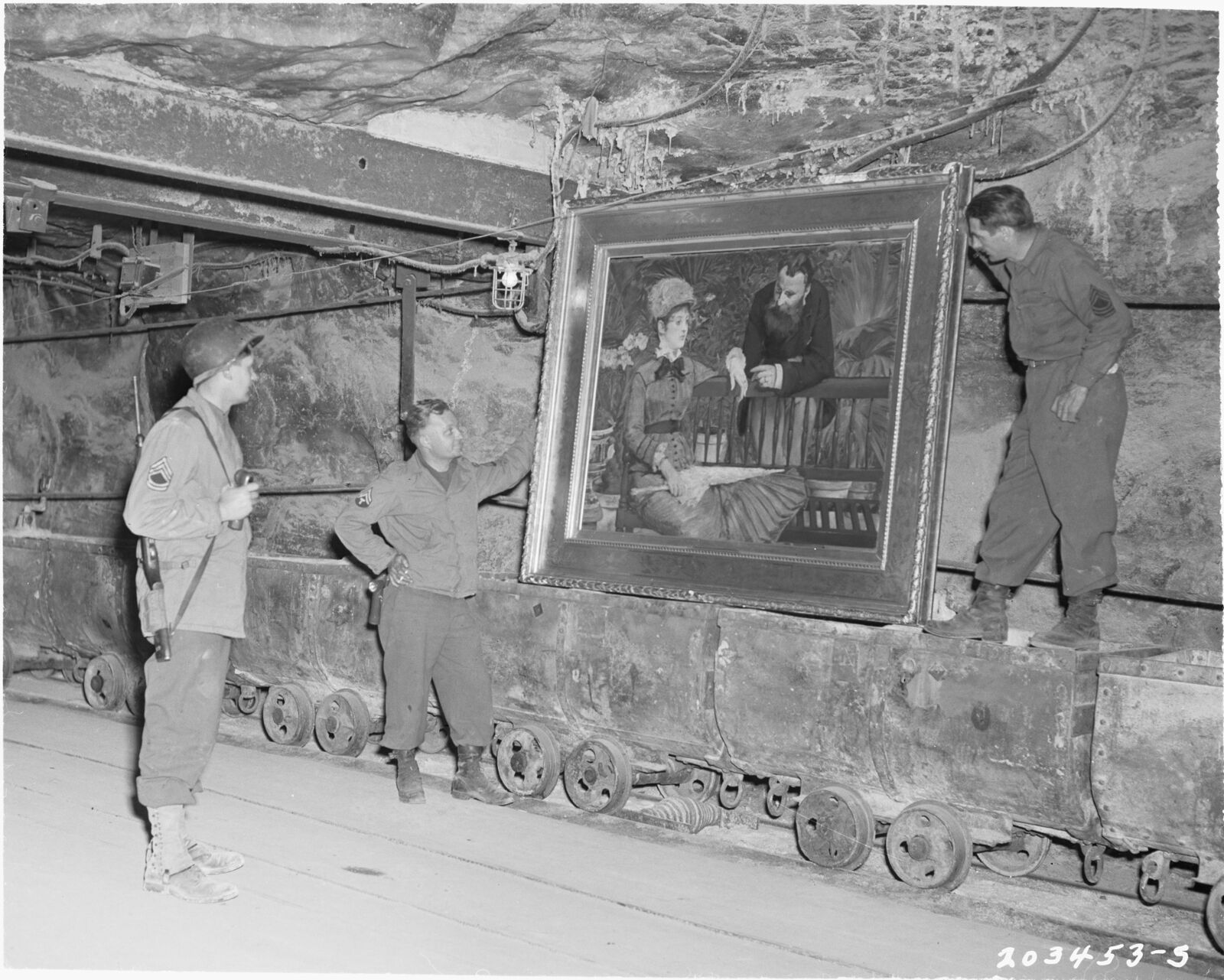
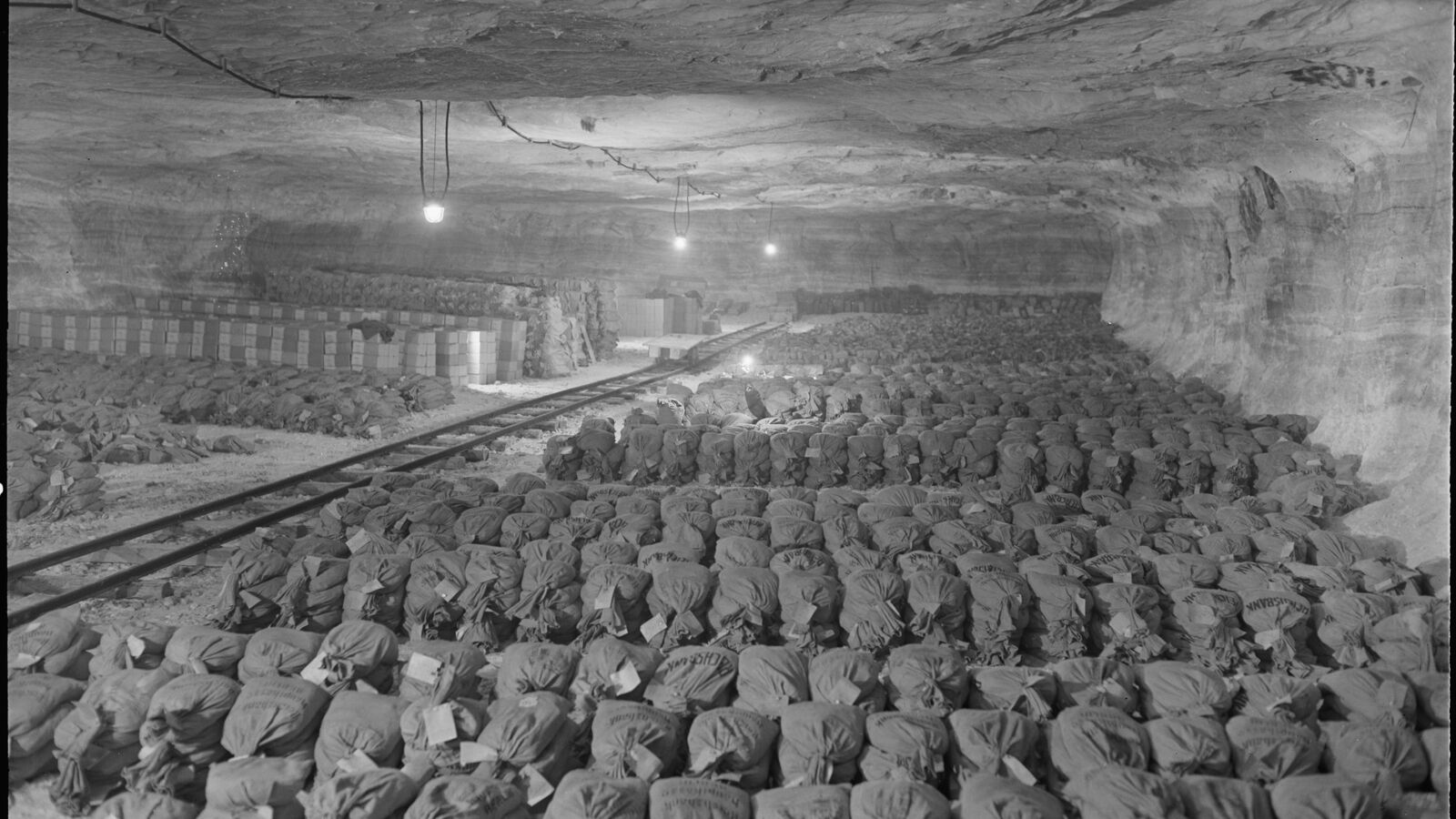
A great part of the art of fourteen Prussian state museums is safe in American hands. The Germans had hidden it in the salt mine at Merkers, a village of Thuringia in the middle of Germany. American soldiers and monuments officers, the Army’s men for saving works of art, found the museums’ pictures, sculpture and ancient papers 2,100 feet beneath Merkers. Some 400 tons of art lay hidden there. The men brought the treasures into the daylight and carried them under guard to Frankfurt.
The village fell to the Third Battalion, 358th Infantry Regiment, of the 90th Division on April 4. Two days later Lt. Col. William A. Russell heard that the mine concealed gold and works of art. Displaced persons, men and women the war had carried far from their own countries, confirmed the report. A German bank officer said the gold represented Berlin’s Reichsbank reserve.
The Germans had sent one-fourth of the principal holdings of fourteen Prussian museums into the mine between March 20 and 31. Captain Robert Posey, a monuments officer with the Third Army, inspected the passages on April 8. With him went his assistant, Private First Class Lincoln Kirstein, who had helped found a school of ballet in New York before the war. Major Perera of the Third Army’s civil-affairs staff went with them. They found sculpture in crates, Egyptian papyri in metal cases and original woodcuts from Albrecht Dürer’s Apocalypse.
Generals Eisenhower, Bradley and Patton descended into the mine on April 12. General Eddy, commander of the XII Corps, came with them. General Weyland, commander of the XIX Tactical Air Command, came too. The mine held gold, currency and art beside the plunder of the SS, the Nazi guard that ran the concentration camps. The plunder included gold teeth taken from concentration-camp victims.
Lt. George Stout, the monuments officer who advised on packing and removal, found the paintings lying without crates. They had to be wrapped, lifted and carried without adding a second ruin to the first.
A platoon began raising the loose paintings on April 15. The next day soldiers and 100 prisoners of war loaded the convoy until evening.
The convoy, called Task Force Hansen, left Merkers on the morning of April 17 with 26 ten-ton trucks carrying art. It reached Frankfurt that afternoon, and the last load was inside the Reichsbank building before night was over.
The inventory counted 393 loose paintings, 2,091 boxes of prints, 1,214 cases and 140 textiles. The collection has since been transferred to the Army’s central collecting point at Wiesbaden, where the work of identifying and protecting it continues.
AND AT ALTAUSSEE. In May the Allied forces reached the salt mines at Altaussee, in Austria. They found more than 6,500 paintings the Nazis had hidden there. Many of them had been taken from the museums, churches and private collections of occupied Europe.