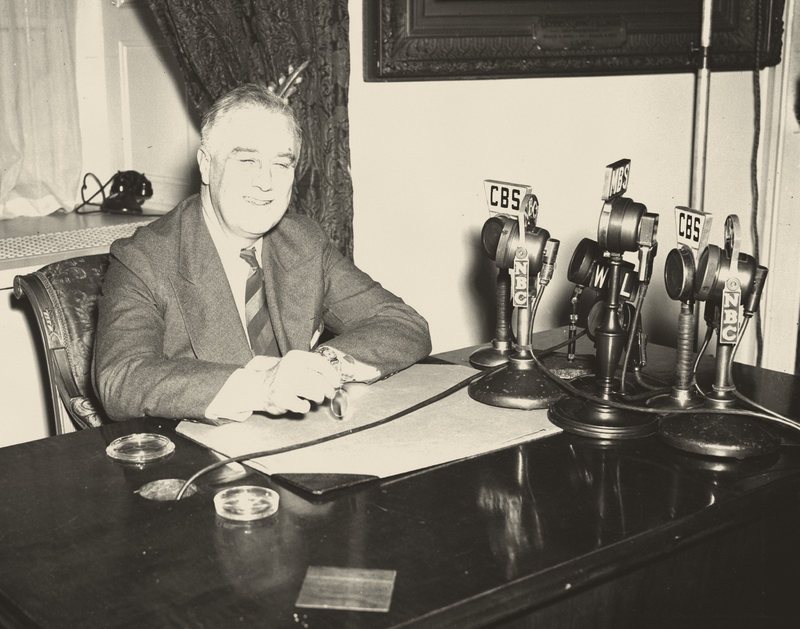
For a generation that grew up in the depression and went to war, his voice on the radio was the voice of the country itself. Eight days after he took office in 1933, he sat down before the microphones to tell the country why the banks had closed. He went on talking to it, by the fireside, through the war, until that voice fell silent on April 12.
Franklin Delano Roosevelt was born at Hyde Park, N.Y., on Jan. 30, 1882, the son of James Roosevelt and Sara Delano Roosevelt. He attended Groton School and completed his Harvard degree in three years. After studying law at Columbia, he passed the bar in 1907 without taking a law degree.
In 1905 he married Eleanor Roosevelt, his distant cousin and a niece of President Theodore Roosevelt. Six children were born to them; five lived past infancy.
IN PUBLIC LIFE
New York elected him to the State Senate in 1910 and again in 1912. President Wilson appointed him Assistant Secretary of the Navy the next year, and he remained there until 1920. As James M. Cox’s running mate that year, he lost to Warren G. Harding.
Then infantile paralysis struck. He was 39. The illness did not end his public life: he established a foundation for polio patients at Warm Springs, the Georgia resort whose warm pools had eased his legs.
With Gov. Alfred E. Smith’s backing he was elected Governor of New York in 1928 and re-elected in 1930.
FOUR ELECTIONS
He defeated Herbert Hoover in 1932, Alfred M. Landon in 1936, Wendell Willkie in 1940 and Thomas E. Dewey last November. No previous President had been elected more than twice.
During his first hundred days, Congress created the Agricultural Adjustment Administration and the Civilian Conservation Corps. The Works Progress Administration, which put the jobless to work on roads, bridges and schools, and Social Security followed. Congress rejected his 1937 proposal to add Justices to the Supreme Court.
After Pearl Harbor on Dec. 7, 1941, he led the country into war. He met Churchill and Stalin at Teheran and again at Yalta to plan the peace. He lived to see American forces land in Normandy and cross the Rhine.