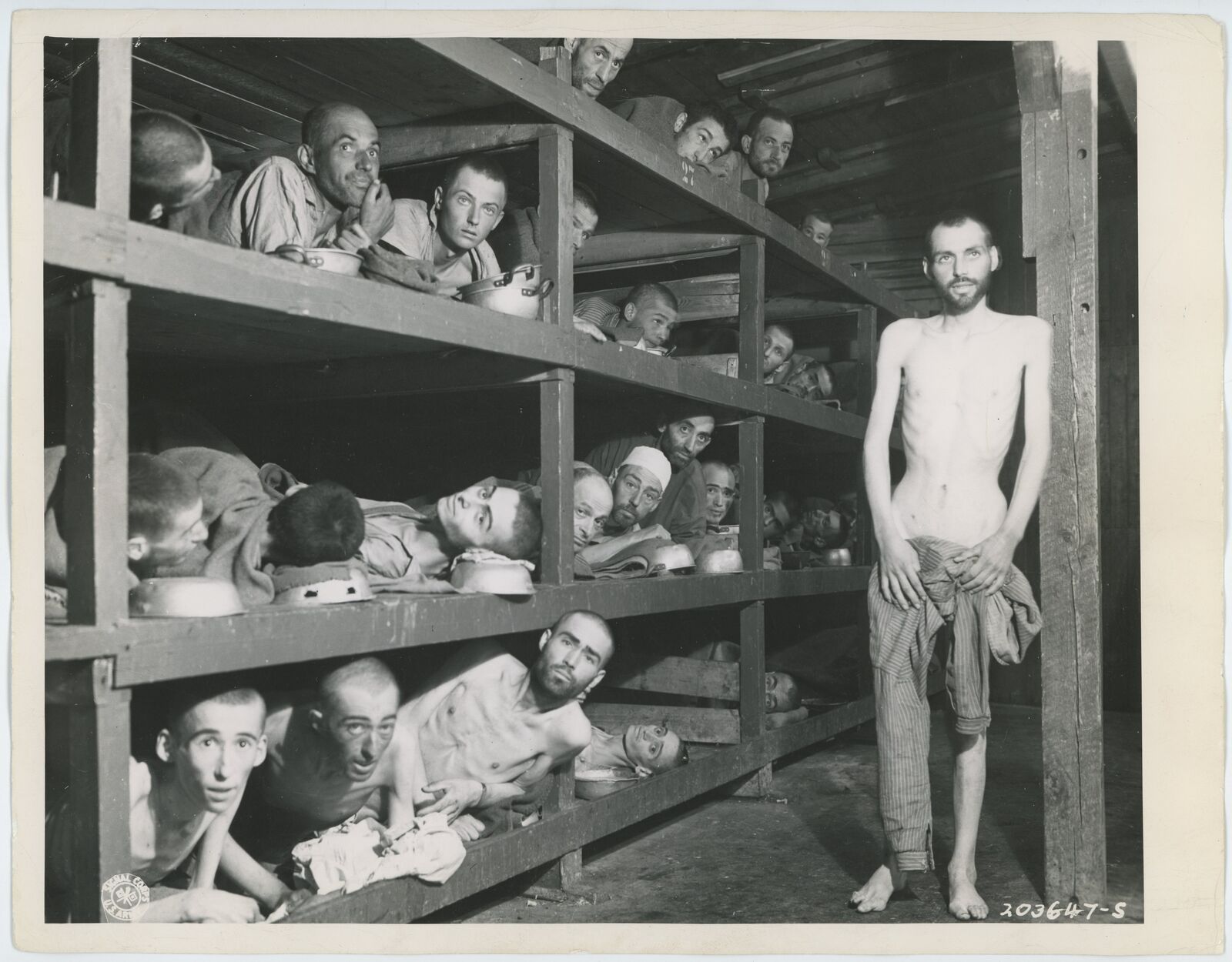
Allied troops opened the Nazi concentration camps this spring, and the world saw the starved and the dead the Germans had left there. For most of those sent into them, freedom came too late.
American troops entered Buchenwald on April 11 and found more than 20,000 prisoners alive among the dead. On April 15 Edward R. Murrow told his listeners: “I pray you to believe what I have said about Buchenwald. I have reported what I saw and heard, but only part of it. For most of it I have no words.”
At Bergen-Belsen, entered by the British in mid-April, thousands of bodies lay unburied among some 55,000 living, many sick with typhus. About 37,000 had died there before the British came. More than 13,000 of the freed prisoners died in the next three months.
Richard Dimbleby of the B.B.C., who went in with the British troops, said in his broadcast: “This day at Belsen was the most horrible of my life.”
Most of the dead were Jews. With them died Romany, political prisoners, prisoners of war and others the Nazis had seized.
The Russians reached Majdanek in July of last year and Auschwitz on January 27, finding more than 6,000 alive.
Americans freed Dachau on April 29. A train had left Buchenwald for it with nearly 4,500 prisoners. At Nammering nearly 800 bodies were put into a common grave.